
Jalpura & Greater Noida West · · 6 min read · By Sorrel Buildcon
Low-Rise vs High-Rise in Greater Noida West — Which Suits You?
Quick answer
The low rise vs high rise choice in Greater Noida West is really a choice between amenities and simplicity. A high-rise gives you a clubhouse, a pool and hundreds of neighbours, with higher maintenance and longer lift waits. A low-rise like Sorrel Heights gives you fewer homes per floor, quieter corridors and simpler upkeep, with a lift, camera security and a recreation room.
What the two words actually mean here
In Greater Noida West, "high-rise" usually means a tower of 15 to 30-plus floors in a gated township of several thousand homes, served by multiple lifts per tower and a central amenity podium. "Low-rise" or mid-rise means a building of roughly three to six floors, with a handful of homes on each floor and a lift serving all of them.
The low rise vs high rise decision is often presented as a budget question. It is not, or not mainly. The same money can buy either, because a low-rise spends on the home and the building while a high-rise spends on shared facilities. What you are really choosing is where you want your money and your monthly maintenance to go.
Searches for low rise apartments greater noida west and searches for large gated towers often end on the same shortlist, because both exist across the area and the choice is genuinely open. For a wider sense of the neighbourhood, read our honest guide to living in Greater Noida West.
Side-by-side comparison
| Households sharing your floor | High-rise: typically 4–8 per lobby with hundreds in the tower. Low-rise: a handful — five at Sorrel Heights. |
|---|---|
| Lift waiting | High-rise: peaks at 8–9 am and 7–9 pm, and a lift under service is felt immediately. Low-rise: usually seconds. |
| Amenities | High-rise: pool, gym, clubhouse, sports courts. Low-rise: focused essentials such as a recreation room. |
| Monthly maintenance | High-rise: higher, because pumps, lifts, pools and large common areas must run. Low-rise: lower and simpler. |
| Privacy | High-rise: more passing footfall, overlooking between towers. Low-rise: quiet landing, fewer eyes. |
| Evacuation in a fire | High-rise: relies on refuge floors and drills. Low-rise: a short staircase to the ground. |
| Power backup load | High-rise: essential, lifts and pumps depend on it. Low-rise: smaller load, simpler system. |
| Community feel | High-rise: large, anonymous, many activities. Low-rise: small, familiar, fewer events. |
Where high-rise living genuinely wins
- Amenities your family will actually use. If someone swims daily or plays badminton three times a week, a clubhouse earns its maintenance charge.
- Children's peer group. A large society means fifty children of the same age in the same park. For many parents this is decisive.
- Views and breeze. A twentieth-floor flat has light and air a four-storey building cannot match.
- Professional management. Big societies usually have full-time facility managers, defined SLAs and 24-hour help desks.
- Organised activity. Festivals, clubs, yoga groups, RWA committees — a ready-made social calendar.
Where low-rise living wins
- Fewer neighbours, less friction. Five homes per floor means you know everyone, parking disputes are rare, and noise transmission is limited.
- No lift queue. You are never waiting behind eleven people on a Monday morning.
- Lower and more predictable maintenance. One lift, one set of pumps, a modest common area.
- Easier evacuation and easier daily life without the lift. Three or four flights is a reasonable fallback; twenty-two floors is not.
- More usable space per rupee. Less of the building's area goes into podiums, double-height lobbies and long corridors.
- Simpler water and drainage. Fewer pressure stages, fewer pumps to fail.
The trade-off is honest: you give up the pool and the gym. Decide whether your family would use them fifty times a year or five.
The questions that separate the two in practice
- How many homes share each lift, and how many lifts are there? Divide, do not guess.
- What is the current monthly maintenance per sq.ft, and what does it cover?
- Who runs the facility — a professional agency, the builder, or a residents' association?
- What is the power backup for lifts, pumps and common lighting, and is there backup to individual flats?
- How is water supplied and stored, and is there a treatment plant?
- Where is visitor parking, and how is it controlled?
- What is the fire safety provision at this height?
- How many homes are already occupied? A half-empty tower still charges full maintenance for facilities nobody staffs.
Ask these alongside the rest of your list in questions to ask a builder before booking.
Who should choose which
Choose a high-rise if you have young children who want a large play group, someone in the family uses a pool or gym regularly, you value professional management over personal familiarity, and a higher monthly maintenance charge sits comfortably in your budget.
Choose a low-rise if you want a quieter building, care more about the home's own specification than shared facilities, dislike waiting for lifts, plan to have elderly parents living with you, or want maintenance costs that stay modest and predictable for decades. Buyers upgrading from a rented tower often make this switch deliberately — see upgrading from a 2BHK to a 3BHK and builder floor vs lift apartment in Jalpura for the two comparisons buyers usually run alongside this one.
How Sorrel Heights is planned
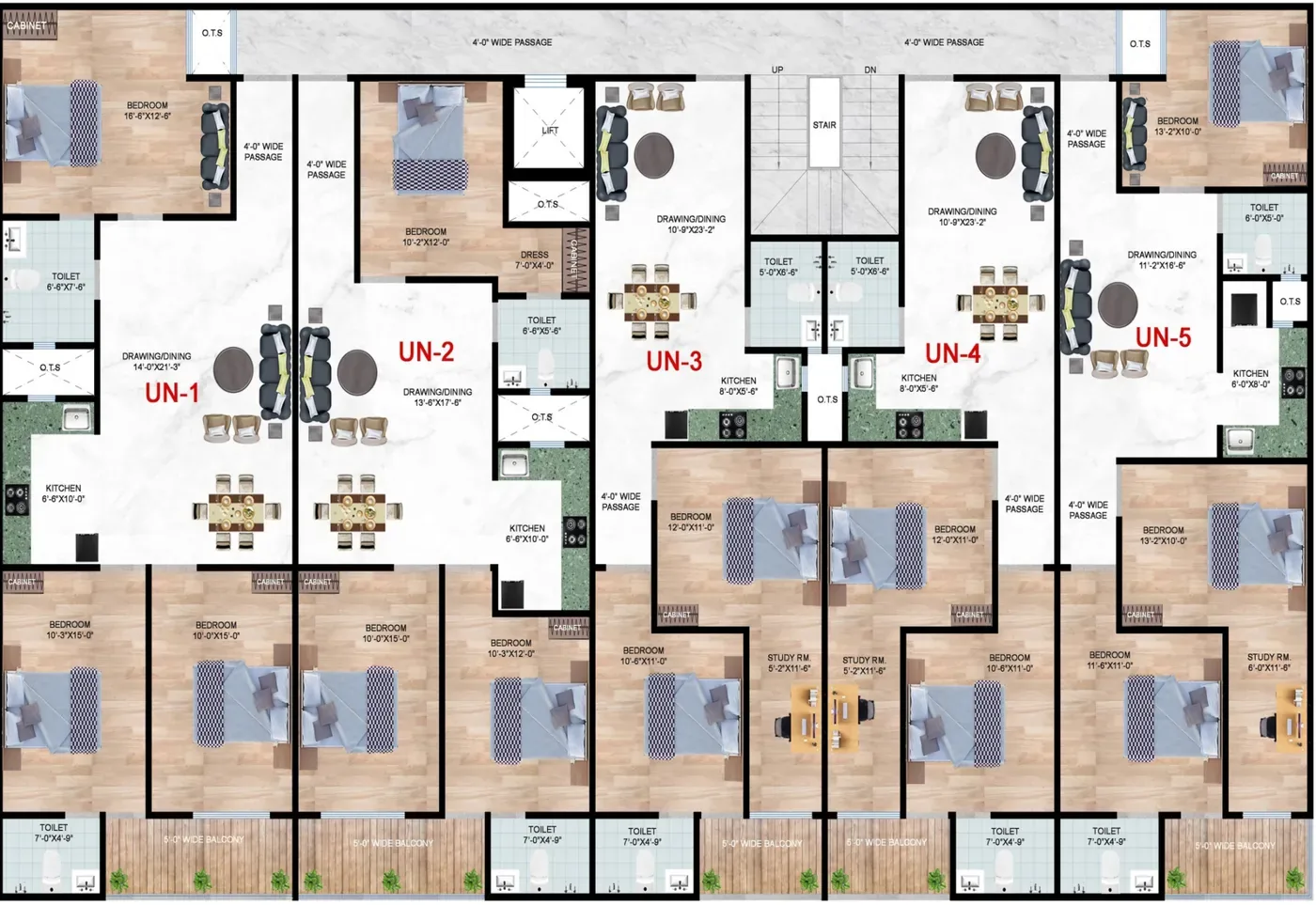
Sorrel Heights, by Sorrel Buildcon Pvt Ltd at Novelty Green, Jalpura, Greater Noida West, is a low-rise project with a lift to all floors and five homes on a typical floor, numbered UN-1 to UN-5 — walked through in five homes per typical floor. The homes are a 2BHK + Study of 1280 sq.ft, three 3BHK layouts of 1700–1750 sq.ft, and duplexes of 1920–2650 sq.ft with open terraces on the top floors.
Rather than a large amenity podium, the project puts its specification into the homes and the building: premium tile flooring, designer false ceiling in all rooms, modular kitchen with granite or marble counter, smart lock on the front door, 24×7 smart motion-detection camera, Cera or equivalent fittings with sensor lights in the toilets, and a recreation room for yoga, exercise, carrom and chess. A roof top garden and lounge room are also listed among Sorrel amenities on the Sorrel Buildcon website. The full list is on Sorrel Heights specifications.
Walk both types before deciding
Spend an evening in a large society and an evening in a low-rise building. Notice the lift wait, the noise on the landing and how many people pass your door. Then ask for the current price list & payment plan sheet, compare all seven layouts on the floor plans, look at the location, and book a visit through contact the Sorrel team.
Lift waits and daily time
In a large tower, peak-hour lift waits can be several minutes. In a building with five homes per floor, lifts serve far fewer people, so waits are short. Over years, that time adds up.
Amenities: what you actually use
Think about which amenities you would use weekly. For many families it is a place for yoga or exercise, somewhere for children to play and a spot for guests to sit — which a recreation room and sit-out area provide. Large pools and clubhouses are enjoyable but come with running costs.
Resale and rental
Both types find buyers. High-rises attract buyers who want big amenities; low- and mid-rise buildings attract those who want bigger homes, quieter floors and lower maintenance. See resale factors.
Facts about Sorrel Heights on this page come from the official brochure and Sorrel Buildcon. General guidance is for information only — confirm rules and rates with the relevant authority before you act.