
Interiors & living · · 6 min read · By Sorrel Buildcon
Wardrobe & Storage Ideas for a Dressing Area
Quick answer
Good wardrobe storage starts with dividing clothes by how often you wear them: daily items between knee and shoulder height, seasonal items in the loft, rarely used items elsewhere. In a dressing area, run full-height units along the longer wall, keep a 900 mm standing space in front, and put the mirror at the far end where light falls on it.
Why a separate dressing area changes storage
Most wardrobe ideas start with a shutter finish. Start instead with where the wardrobe goes. In most Indian flats the wardrobe fights the bed for wall space, and the bedroom ends up feeling like a corridor between two large boxes. A dressing area solves that by moving the clothes out. The bedroom keeps its window wall and its calm; the dressing area takes the wardrobes, the mirror and the daily mess of getting ready.
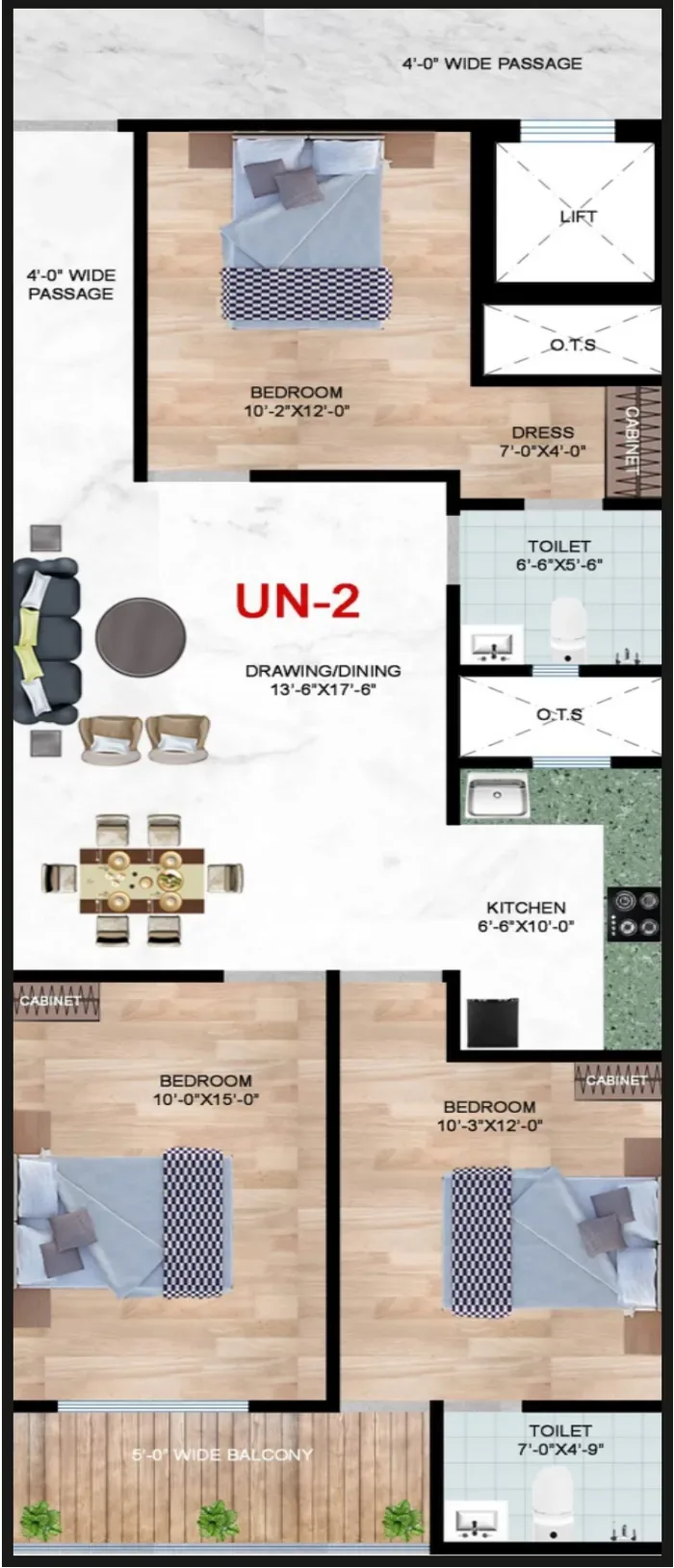
It also changes how the family uses mornings. Two people can dress without one waiting for the other, ironing happens away from the bed, and the bedroom door can stay shut while someone is still asleep. At Sorrel Heights the 3BHK Type B (1700 sq.ft) includes a dressing area of 7′-0″ × 4′-0″, and the 2550 sq.ft duplex UN-2 includes one as well. Read dressing vs study in Type B and Type C if you are choosing between them.
Planning a 7′ × 4′ dressing area
Four feet of width sounds tight until you do the arithmetic. A wardrobe with a hanging rail needs about 600 mm of depth. Put units on one long side and you still keep roughly 600 mm of standing room; use sliding shutters and nothing swings into that space.
- One long side of full-height units, 600 mm deep, 2100 mm of usable height plus a loft above.
- Opposite wall kept shallow — a 250 mm deep shelf strip, hooks, or simply a full-length mirror.
- Far end for the mirror, so you can step back from it.
- Sliding shutters in a narrow area; hinged shutters only where you have 900 mm clear in front.
- Light at the front of the wardrobe, not behind your head, plus a neutral-white strip near the mirror so you can judge colours honestly.
What goes inside the wardrobe
The wardrobe ideas that pay for themselves are internal. Most wardrobes are wasted by having one long rail and one deep shelf; divide the internal height instead.
| Zone | Height from floor | What it holds |
|---|---|---|
| Loft | 2100 mm and above | Suitcases, winter quilts, festival items |
| Long hanging | 1200–2050 mm | Sarees, suits, kurtas, coats, long dresses |
| Short hanging | 1100–2050 mm (double bank) | Shirts, tops, trousers on clips |
| Drawers | 500–1100 mm | Innerwear, accessories, jewellery tray, belts |
| Open shelves | 500–1100 mm | Folded jeans, sweaters, gym wear |
| Base | Below 500 mm | Shoe pull-out, laundry basket, bags |
Practical extras worth the money: a pull-out trouser rack, a shallow drawer with felt inserts for jewellery, a full-length mirror inside a shutter, and one soft-close hinge per door so shutters do not bang.
Sliding vs hinged shutters
Both have a real trade-off, and the room decides more than taste does.
- Sliding needs no clearance in front, suits narrow dressing areas and passages, and looks cleaner. But you can only ever see half the wardrobe at once, tracks collect dust, and door width is limited by the panel size.
- Hinged gives full access to the whole interior, allows internal mirrors and door-mounted racks, and costs less per running foot. But it needs about 600–900 mm of swing space and a floor free of rugs.
A common compromise in a 3BHK: hinged shutters in the bedrooms where space allows, sliding in the dressing area and any passage unit. For finishes, laminate on marine-grade plywood remains the practical choice in NCR humidity; acrylic shutters look excellent but show fingerprints and cost more.
Storage in the rest of the home
A family of four generates more storage demand than any dressing area can absorb, so plan the rest of the flat at the same time.
- Hydraulic or drawer beds in every bedroom — the single biggest hidden volume in a flat.
- Shoe cabinet by the entrance, ventilated, deep enough for 300 mm shoes.
- Tall unit in the modular kitchen for groceries, with a pull-out for oil and spices near the hob. See the modular kitchen guide.
- Utility storage on the balcony for buckets, tools and the vacuum cleaner, in a closed weatherproof cabinet.
- A shallow console or wall unit in the living area for documents, chargers and keys.
- A loft over the toilet door or passage for luggage, if the ceiling height allows.
Our wide balcony ideas cover how to add storage on a balcony without losing the light.
Keeping clothes in good condition
Delhi NCR gives you dust for eight months and humidity for three, so storage is also preservation. Line the base of hanging sections with a washable sheet. Keep naphthalene or neem-based repellent in cotton pouches rather than loose. Never store cottons or silks in airtight polythene for a whole season — they need to breathe; use cotton saree bags instead.
Leave a 20 mm air gap between the wardrobe back panel and any external wall, since that wall can carry condensation in winter. Air the wardrobe for an hour once a month, especially after the monsoon, and check the loft for damp. If the flat has been closed for weeks, run a fan in the dressing area before restocking it.
Order of work when you move in
Do not act on all your wardrobe ideas in one go.
Move in with a hanging rail and two suitcases, live for three weeks, then measure again. You will discover that you need more drawers and fewer shelves than you assumed, and that one family member owns twice as much long hanging as you planned for.
- Week one: hanging rail, laundry basket, shoe rack.
- Week three: finalise internal layout after watching actual use.
- Month two: order the dressing area units and the bedroom wardrobes together to get one price.
- Month three: lofts, balcony utility cabinet, kitchen tall unit.
Read the moving-in checklist so the joinery does not clash with electrical and curtain work.
See the homes with a dressing area
If a dressing area is on your wish list, look at the 3BHK Type B (1700 sq.ft, two toilets, with dressing) and the 2550 sq.ft duplex UN-2 at Sorrel Heights, Jalpura, Greater Noida West. Indicative all-inclusive pricing is ₹60–70 lakh for the 3BHK homes and under ₹1 crore for the duplexes, as shared by Sorrel Buildcon and revised from time to time.
Check dimensions on the floor plans, compare the 3BHK layouts and the duplex homes, see what is already fitted in the specifications, ask for the current cost sheet on price list & payment plan, or book a site visit and bring a measuring tape.
Seasonal rotation
Store winter clothes in the upper lofts in summer and swap in October. Vacuum bags reduce bulk. Label boxes so the swap takes minutes.
Lighting in the dressing area
A good mirror light and an LED strip inside wardrobes make a big difference in a small space. Choose neutral white for accurate colours.
Without a dressing area
In homes without one, a tall wardrobe with sliding doors along the longest bedroom wall and under-bed storage cover most needs.
Facts about Sorrel Heights on this page come from the official brochure and Sorrel Buildcon. General guidance is for information only — confirm rules and rates with the relevant authority before you act.