
Interiors & living · · 6 min read · By Sorrel Buildcon
Kids Study Room Setup That Children Actually Use
Quick answer
A good kids study room setup is built around four things: a desk placed side-on to daylight, a chair and desk height matched to the child, layered light with a task lamp for evenings, and storage that keeps current books within arm's reach. Keep toys and screens outside the study zone, and give the room one clear surface the child does not have to clear before starting work.
What makes a kids study room setup work
Children abandon study corners for predictable reasons: the chair is uncomfortable, the light is poor, the surface is always covered in something else, or the spot is so isolated that homework feels like punishment. A kids study room setup that lasts solves all four. It sits in a room the child already likes, has a chair that fits, has enough light at 7 pm as well as 7 am, and has a home for every object so the desk starts empty.
Age matters too. A six-year-old needs a parent within earshot and twenty-minute work blocks. A fourteen-year-old needs quiet, a bigger surface for reference books and a laptop, and a door that can be shut. Plan for the child you have now, but pick furniture that can be adjusted for the child in three years.
Desk and chair: the measurements that matter
Get this right and posture problems largely disappear. The rule is simple: feet flat on the floor or on a footrest, knees at roughly a right angle, elbows level with the desk surface, and the top of the screen or book slightly below eye level.
| Child height | Desk height | Seat height |
|---|---|---|
| 110–120 cm | 52–55 cm | 32–35 cm |
| 120–135 cm | 56–60 cm | 35–39 cm |
| 135–150 cm | 61–66 cm | 39–43 cm |
| 150–165 cm | 67–72 cm | 43–46 cm |
| Above 165 cm | 73–76 cm (adult) | 46–48 cm |
An adjustable chair with a footrest is the cheapest way to cover several years. Desk depth of 550–600 mm and width of at least 1000 mm lets a notebook, a textbook and a lamp coexist.
Lighting a study corner properly
Use two layers. Ambient light from the ceiling stops the room feeling like a cave and reduces contrast between the page and the surroundings. Task light from a lamp puts brightness where the work is. For a study surface, aim for roughly 300–500 lux measured at the desk; a 6–9 W LED task lamp with a diffuser is usually enough.
- Place daylight to the side of the desk, not behind the child's head (shadow) or directly in front (glare).
- For a right-handed child, put the task lamp on the left, and the reverse for a left-handed child, so the writing hand does not cast a shadow.
- Use neutral white, around 4000K, at the desk. Warm light is lovely for a bedroom and slightly sleepy for algebra.
- Avoid a single bright point source in a dark room — it tires the eyes quickly.
Sorrel Heights homes come with a designer false ceiling in all rooms, which makes it easy to plan downlights around the desk position — see lighting ideas for a designer false ceiling and check the specifications for what is already fitted.
Storage that keeps the desk clear
The guiding principle is distance by frequency. Things used daily go within arm's reach, things used weekly go on a shelf, things used termly go into a cupboard or a loft box.
- Arm's reach: current textbooks, notebooks, pencil cup, water bottle coaster.
- Open shelf above the desk: reference books, atlas, dictionary, art supplies in labelled boxes.
- Two drawers: stationery refills, geometry box, chargers.
- Closed cabinet or loft: last year's books, project material, exam papers.
- A pin-board or magnetic strip: timetable, exam dates, one piece of the child's own work.
Keep toys physically out of the study zone, even if the room is shared. If storage is tight across the home, our wardrobe and storage ideas cover lofts, under-bed drawers and shared-room solutions.
Screens, noise and concentration
Position the screen so an adult walking past can see it. That single decision does more for healthy screen habits than any lecture. Put the charging point for tablets and phones outside the bedroom — a shelf in the living area works — so devices leave the study zone at night.
For noise, soft furnishings help more than you expect: a curtain, a rug and a fabric pin-board absorb enough reflection to make a small room feel calmer. Keep the study wall away from the television wall if the plan allows. Agree simple rules with the child: a fixed start time, twenty-five minutes of work followed by a five-minute break for younger children, no notifications during blocks, and a visible timer instead of a parent repeating reminders.
Where to put the study in a 2BHK or 3BHK
You have three realistic options, in order of preference.
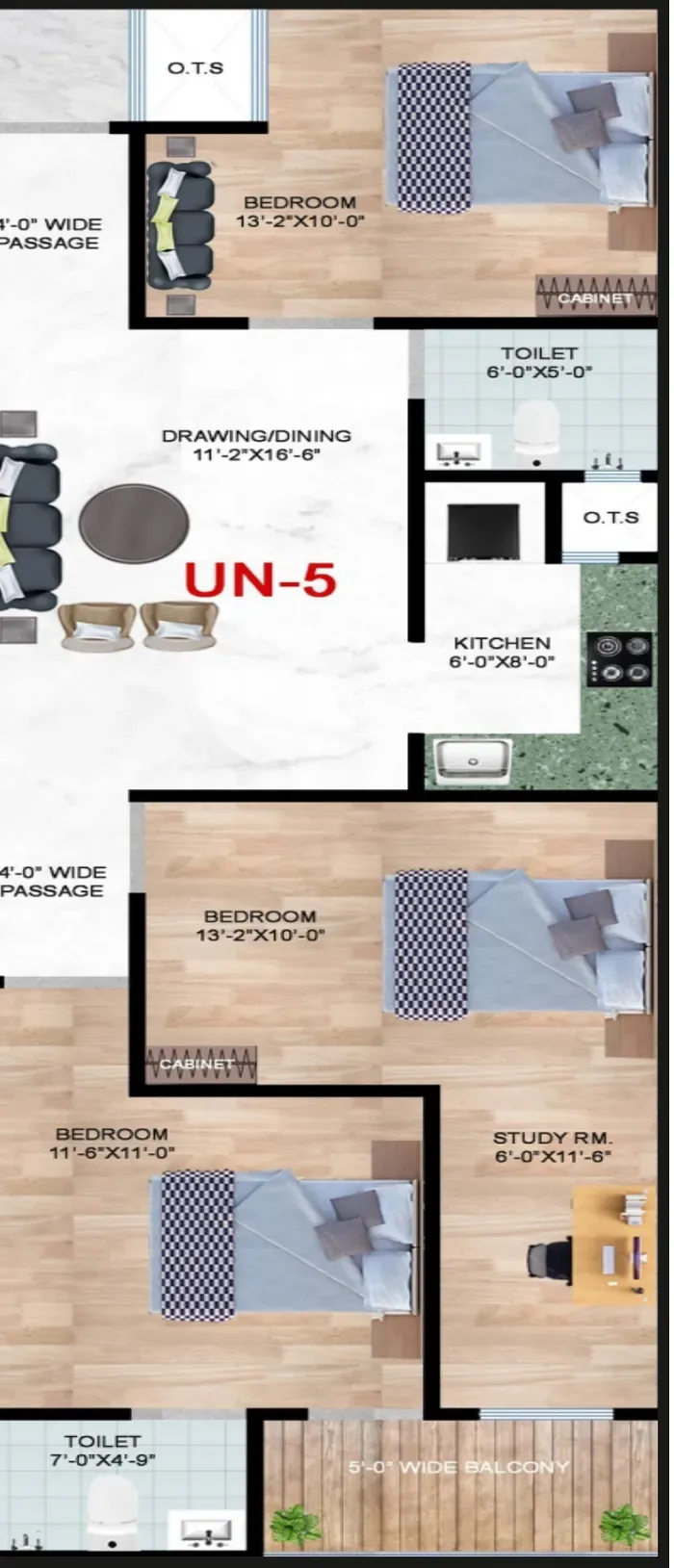
- A dedicated study room. The 2BHK + Study at Sorrel Heights (1280 sq.ft) and 3BHK Type C (1700 sq.ft, with study) both give you a separate space that does not have to double as a bedroom. Duplex homes include a study as well.
- A corner of the child's bedroom. Desk under or beside the window, bed along the opposite wall, wardrobe near the door. This works well from about age eight.
- A shared family work zone. A 1200 mm desk in the living or dining area suits younger children who need supervision, and doubles as a work-from-home spot in the day.
See how the 2BHK study works for work from home and Type B dressing vs Type C study before you choose.
A shared room with two children
Two desks side by side on one long wall, with a low shelf divider between them, works better than two desks facing each other — eye contact is the enemy of homework. Give each child their own lamp, their own drawer unit and their own pin-board so ownership is obvious. If ages differ a lot, stagger study times rather than trying to make one setup serve both, and let the older child use the dedicated study while the younger one works at the family desk.
In a 1700–1750 sq.ft 3BHK the second and third bedrooms comfortably take a bed, a desk and a wardrobe along the walls; our 3BHK furniture layout tips show how the pieces fall into place.
See the homes with a separate study
If a dedicated study is on your list, Sorrel Heights in Jalpura, Greater Noida West has three routes to it: the 2BHK + Study at 1280 sq.ft (indicatively under ₹50 lakh, all-inclusive), the 3BHK Type C at 1700 sq.ft with study, and the duplex homes which include a study plus an open terrace. Prices are approximate, shared by Sorrel Buildcon and revised from time to time.
Look at room dimensions on the floor plans, ask for the current cost sheet on price list & payment plan, and book a site visit so your child can stand in the study and tell you whether the desk will face the window.
Screens and focus
Keep the laptop or tablet facing the door so parents can see the screen. Use a simple timetable on the wall and a basket for devices at bedtime.
Growing with the child
Choose a desk that works from primary to secondary school, and shelves that can be raised. A pin board lets children display work and plan their week.
Sharing the study
If parents also use the study, split time slots — children after school, parents in the morning — and give each person a drawer.
Facts about Sorrel Heights on this page come from the official brochure and Sorrel Buildcon. General guidance is for information only — confirm rules and rates with the relevant authority before you act.